November 28, 2026
🔬 Today in AI Research
From 34 articles considered today, here are the highlights — your daily brew.
📋 Today's Research
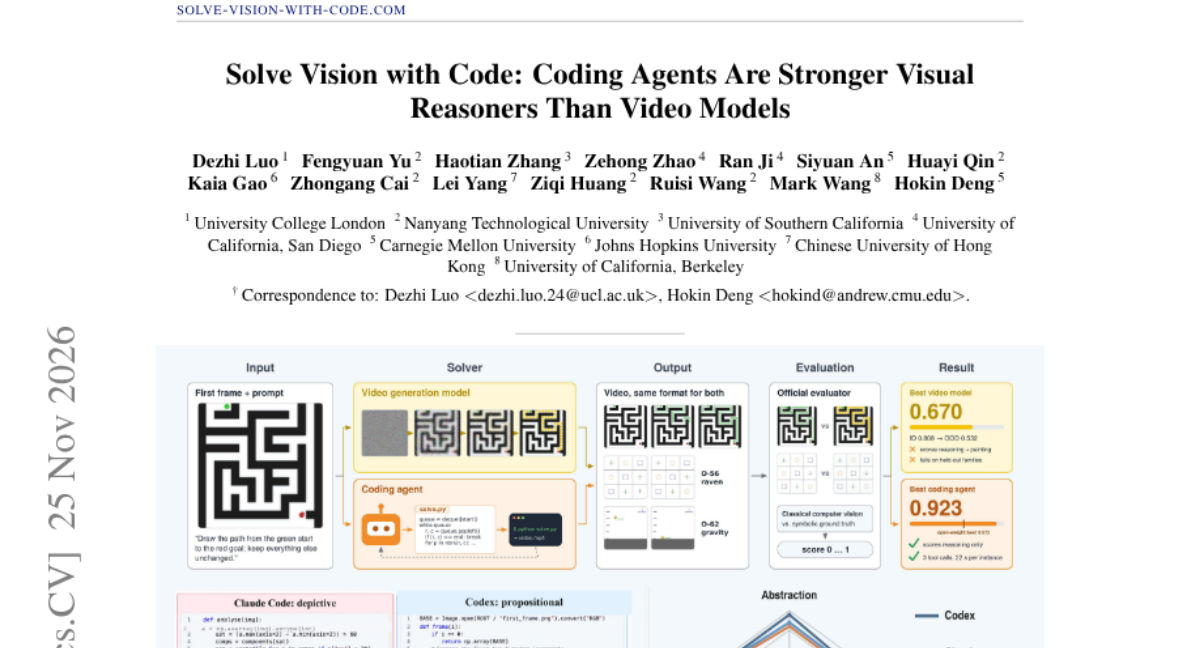
- Coding agents can solve vision better than video models by using code to perform visual reasoning. (huggingface.co)
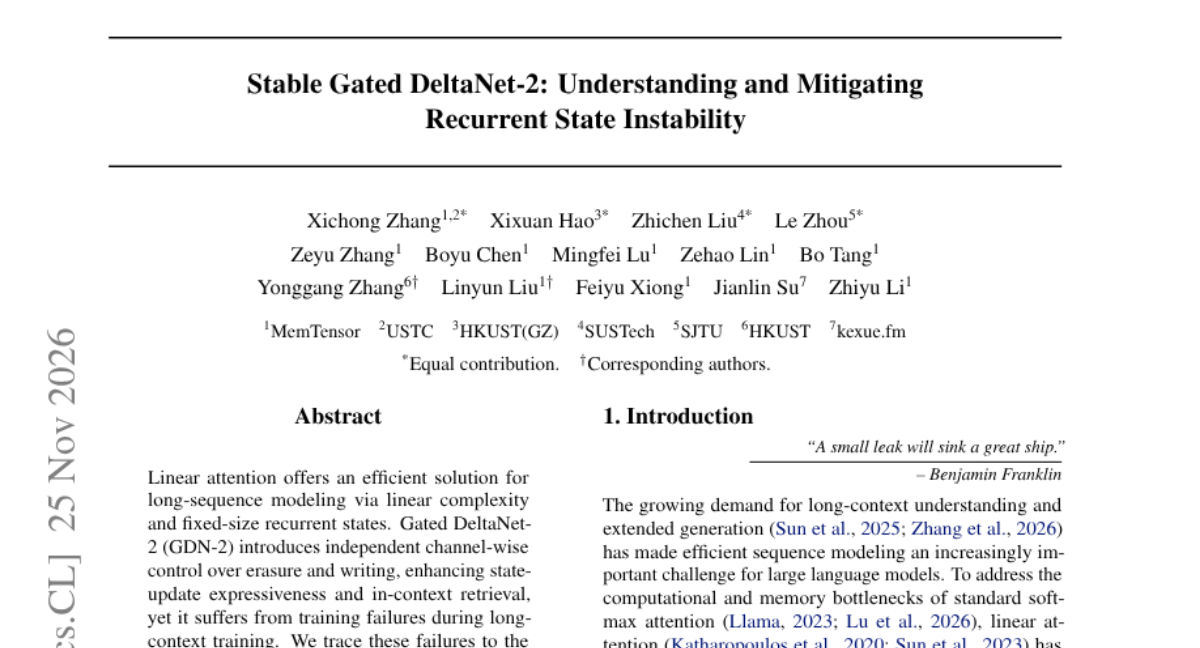
- Stable Gated DeltaNet-2 tackles recurrent state instability by designing gating to reduce recurring hidden-state failures. (huggingface.co)
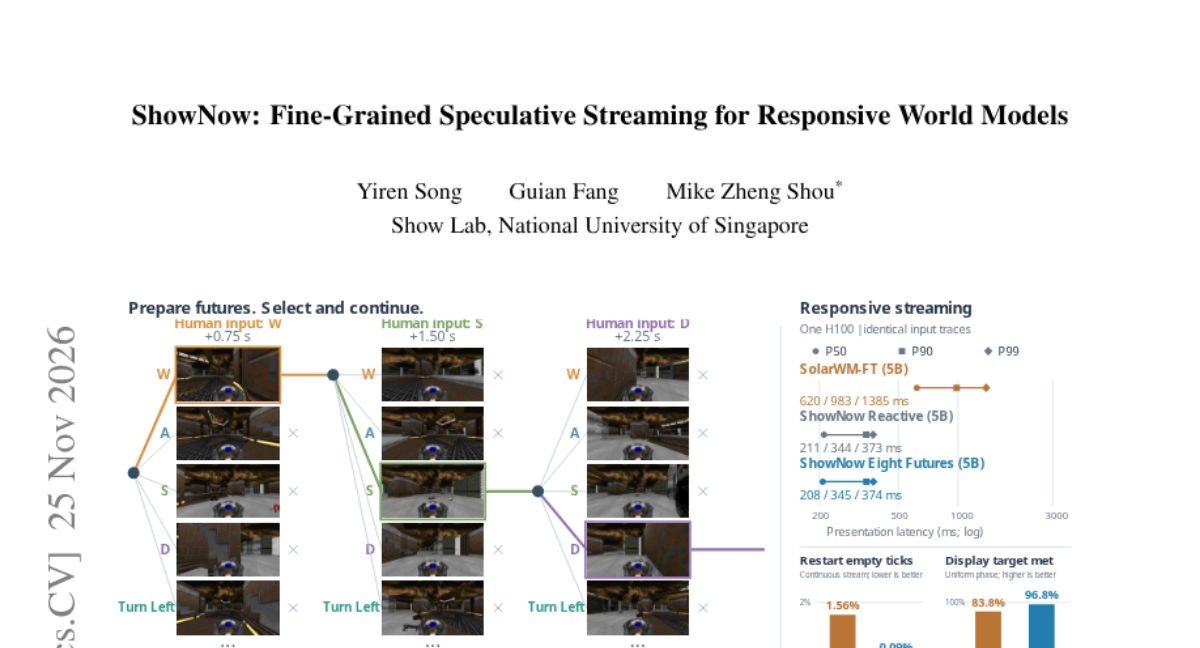
- ShowNow improves world-model responsiveness with fine-grained speculative streaming that generates ahead while refining outputs over time. (huggingface.co)
🔬 Research of the Day
Source: huggingface.co
Quick Brief:
Coding agents that write programs to render answer videos beat state-of-the-art video generation models on a standardized visual reasoning benchmark, even when both get the same first frame, prompt, and evaluator.
The Details:
- On VBVR-Pro-Bench (5k+ instances, 5 cognitive categories), both systems see: first frame + text prompt; both are scored by the same rule-based evaluator.
- Video models output pixels directly; coding agents output code that, when run, renders the answer video.
- Closed-source coding agents (Codex, Claude Code, Gemini CLI) score 0.89–0.92, over 0.22 higher than the best video model.
- Best open-weight coding agent (GLM-5) reaches 0.57, beating all video models except one RL-trained system.
Why It Matters:
Shows that for many “video reasoning” tasks, program synthesis is currently more reliable than direct video generation. Suggests multimodal systems should often route visual tasks through code + simple renderers, not just bigger video models. Implies many video benchmarks mainly test abstract reasoning from a single frame, not rich temporal perception.
💡 Worth a Closer Look
Source: huggingface.co
Quick Brief:
Stable GDN-2 is a linear-attention model that fixes GDN-2’s recurrent state blow-up on long contexts while improving long-range retrieval and accuracy.
The Details:
- Finds instability comes from asymmetric erase/write, yielding non-normal operators and exponential state growth.
- Uses symmetric erasure for aligned read/modify and non-expansive, stable state updates.
- Adds decay-regulated residual writing to keep expressive channel-wise memory but control accumulation.
- Proves O(√T) state growth; on ~1.6B models: +6.8 RULER@128K, +0.62 avg accuracy over 9 tasks vs GDN-2.
Why It Matters:
Enables long-context linear attention that is stable, accurate, and efficient (fixed-size state, chunkwise parallel), offering a principled recipe for robust recurrent memory.
📝 Also Noteworthy
🎮 ShowNow slashes video world-model latency by precomputing action-conditioned futures in real time.
Source: huggingface.co
Quick Brief:
ShowNow precomputes multiple action-conditioned video futures while you watch, so actions switch instantly—cutting input-to-display latency by ~3× while staying real-time on one H100.
The Details:
- 1–8 futures prepared during playback
- Single-latent, fine-grained commitment for fast updates
- Shared-history execution: 480p @16 fps with 8 futures
- ViZDoom: latency 620→208 ms; misses 1.56%→0.09%
Why It Matters:
Makes video world models feel responsive and game-like, and shows how to use idle compute to pre-roll futures for low-latency interaction.
👀 One More to Watch
Source: huggingface.co
Quick Brief:
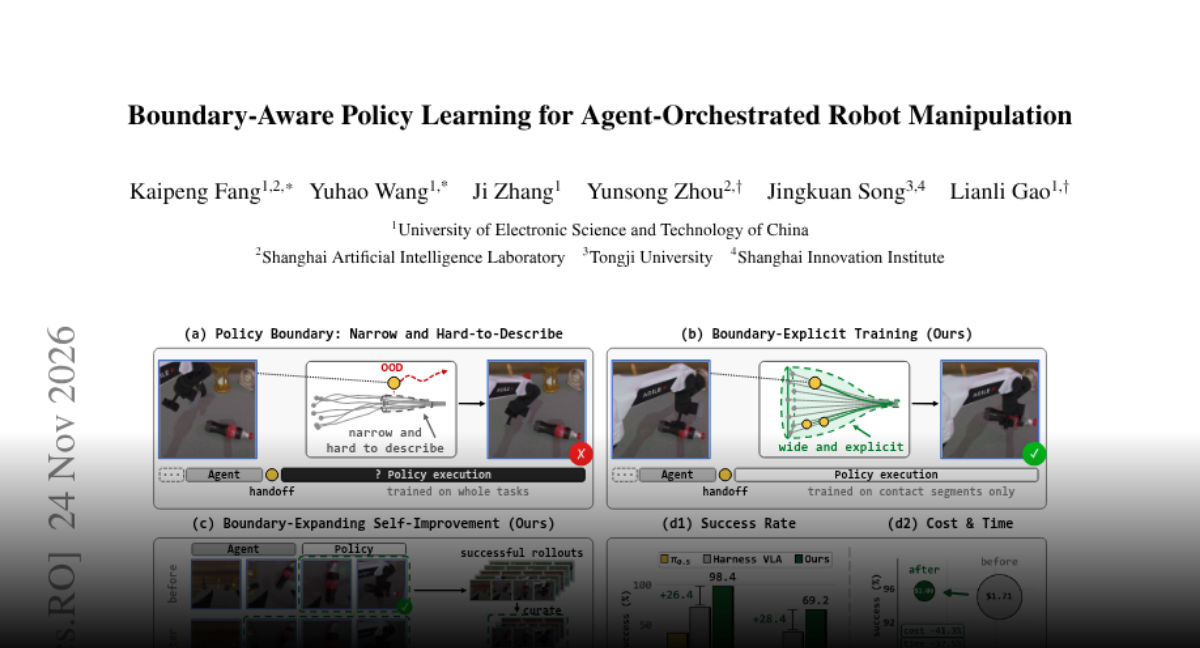
BAPL makes LLM-orchestrated robot manipulation more reliable by learning the “handoff boundary” — when a visuomotor policy can safely take over.
The Details:
- Learns the policy’s reliable start states.
- Boundary-Explicit Training: diverse contact segments → wide, simple boundary.
- Boundary-Expanding Self-Improvement: successful rollouts → earlier handoff, fewer LLM calls.
- 98.4% RoboTwin, 69.2% RoboDojo; 41% lower cost, 38% faster.
Why It Matters:
Fixes when the agent hands control to the policy, yielding more robust, cheaper, faster LLM-robot systems and a general recipe for when agents should call tools.
📚 More Worth Reading
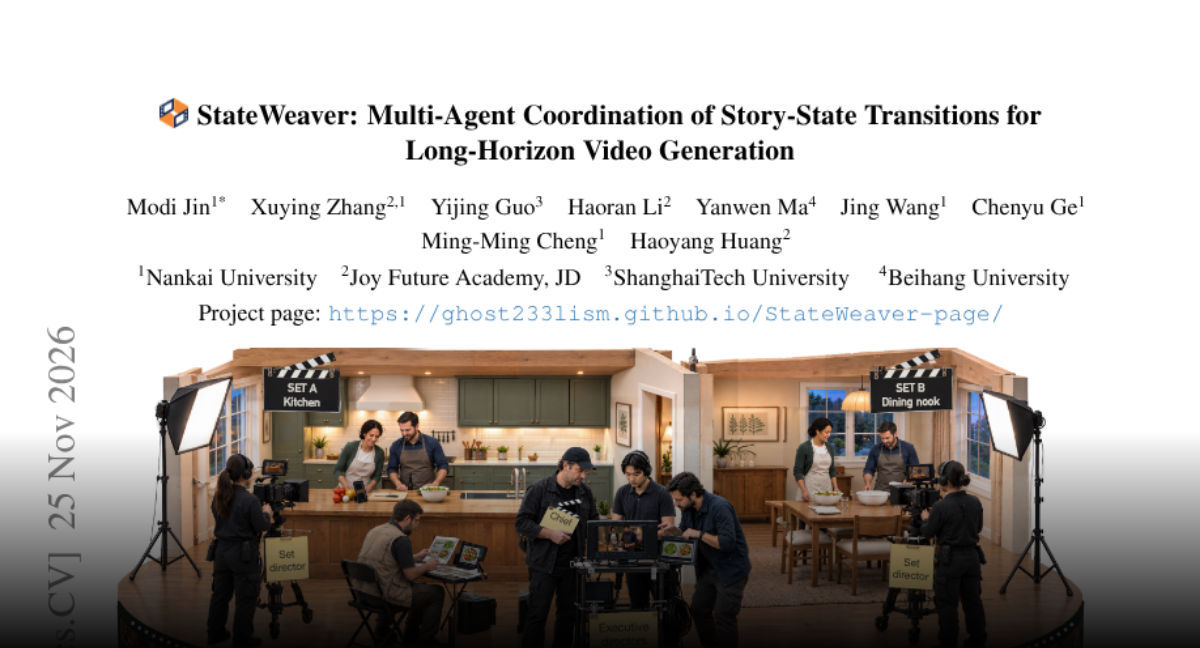 StateWeaver: Multi-Agent Coordination of Story-State Transitions for Long-Horizon Video Generation2026-11-27· huggingface.coIntroduces a multi-agent workflow with Active States and Hierarchical Collaboration that tracks and updates visual references across shots, preserving identities and event-driven state changes to sustain long-horizon video consistency and outperform prior long-video generation methods.
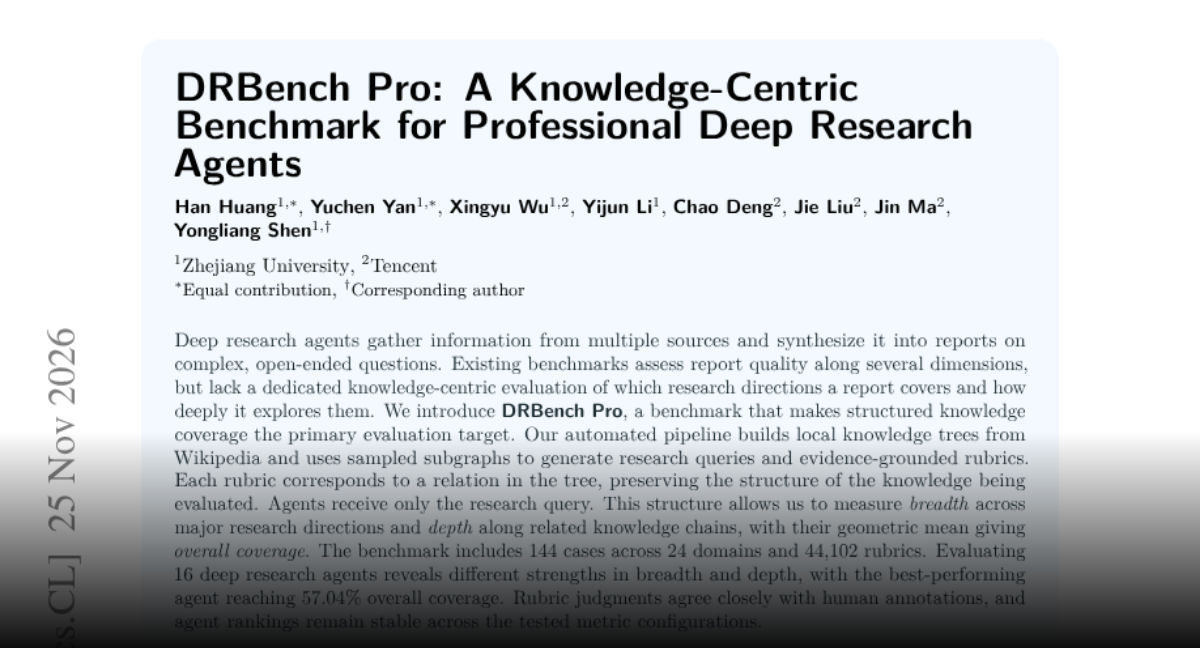 DRBench Pro: A Knowledge-Centric Benchmark for Professional Deep Research Agents2026-11-27· huggingface.coKnowledge-centric benchmark that builds Wikipedia-based knowledge trees and rubric graphs to score deep research agents on breadth and depth of covered research directions, reporting stable, human-aligned coverage metrics across 144 cases, 24 domains, and 16 agent setups.
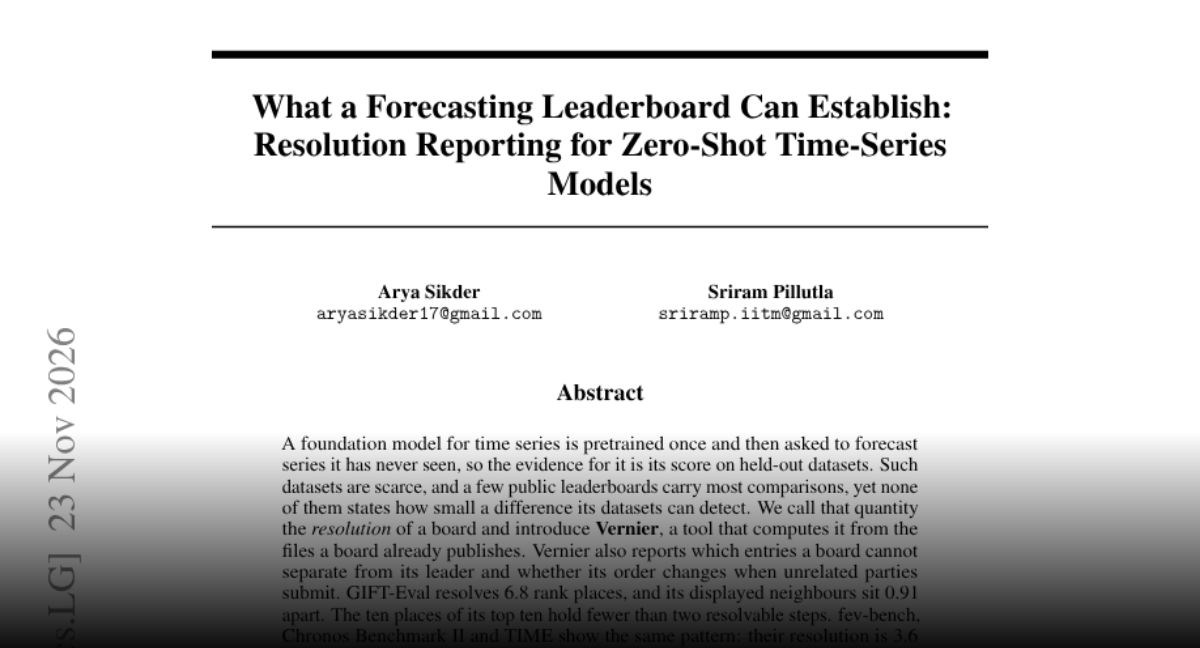 What a Forecasting Leaderboard Can Establish: Resolution Reporting for Zero-Shot Time-Series Models2026-11-27· huggingface.coVernier quantifies leaderboard resolution for zero-shot time-series benchmarks, revealing many cannot reliably distinguish top models, that rank order can flip with new submissions, and that unreported context length can change open-model errors by up to 15%.
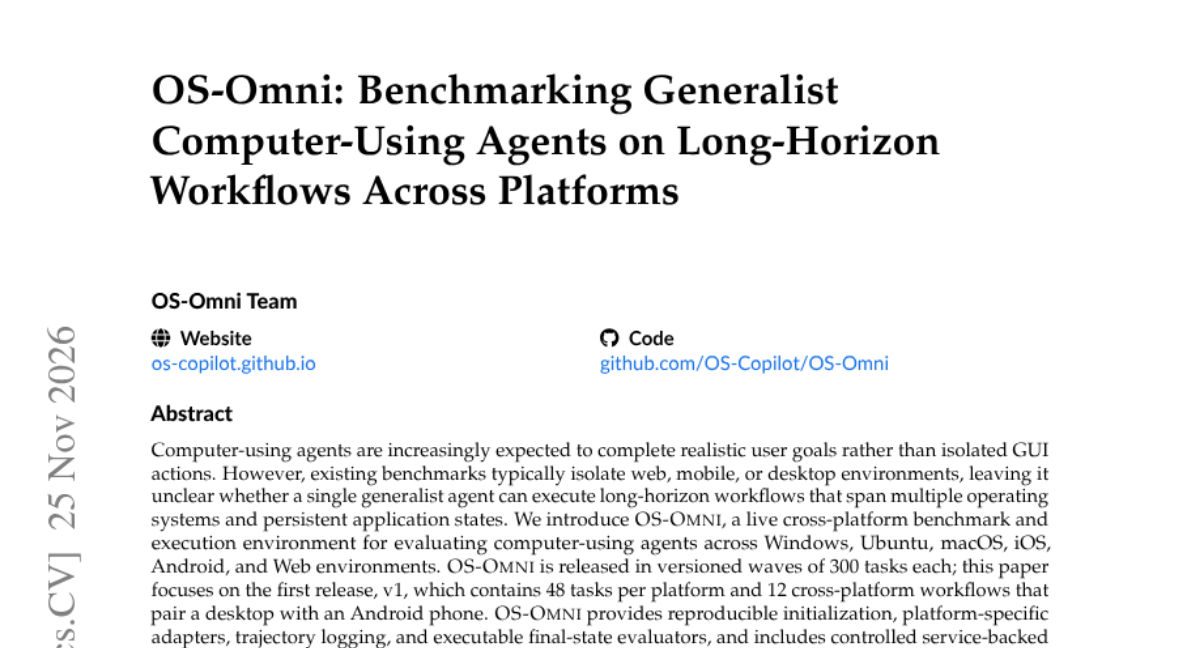 OS-Omni: Benchmarking Generalist Computer-Using Agents on Long-Horizon Workflows Across Platforms2026-11-27· huggingface.coLive cross-platform benchmark and execution environment for long-horizon, stateful computer-use workflows across six OSes, revealing an 8.8-point average performance gap between top agents and humans and >25-point deficits on iOS and macOS.
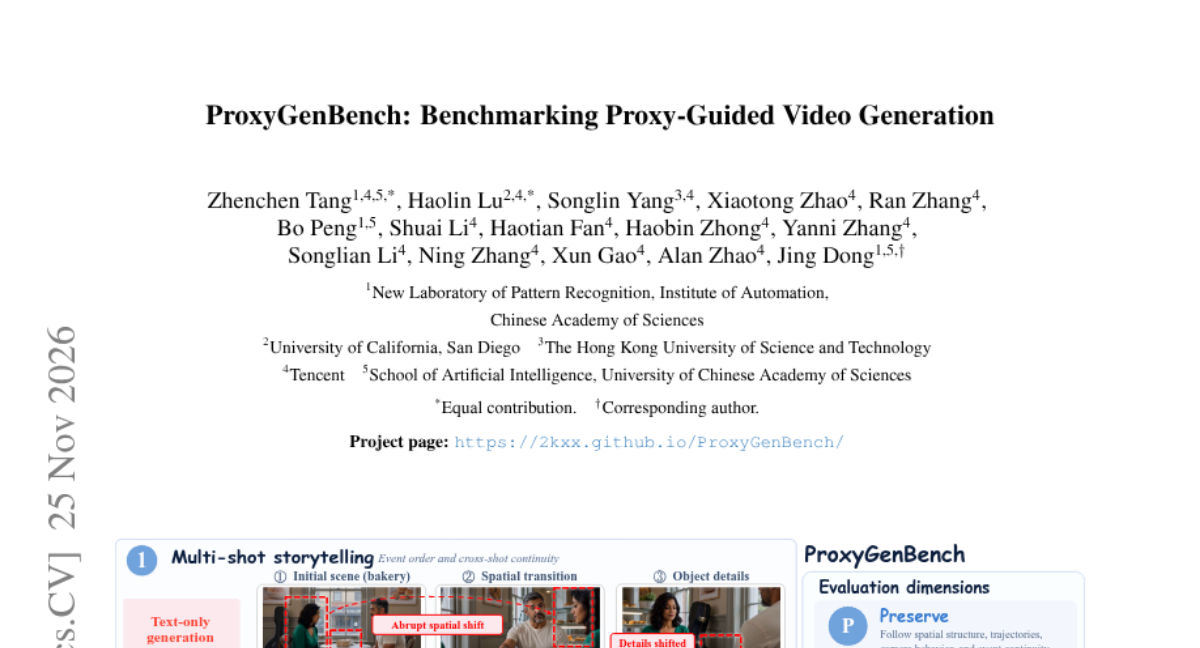 Defines a 312-case benchmark of proxy-guided video generation that tests structural preservation, content completion, and multimodal binding, revealing that more detailed structural proxies can hurt completion and that strong structural adherence does not guarantee correct condition binding.