October 15, 2026
🔬 Today in AI Research
From 42 articles considered today, here are the highlights — your daily brew.
📋 Today's Research
- VideoJev proposes a System One model for video understanding and interaction. (huggingface.co)
- WAVE-0 bridges VLA policies and WAMs using lightweight latent future prediction. (huggingface.co)
- Leash Bio runs lab-in-the-loop at compute speed, tames DELs assays, and uses the resulting data to catch cheating. (latent.space)
🔬 Research of the Day
Source: huggingface.co
Quick Brief:
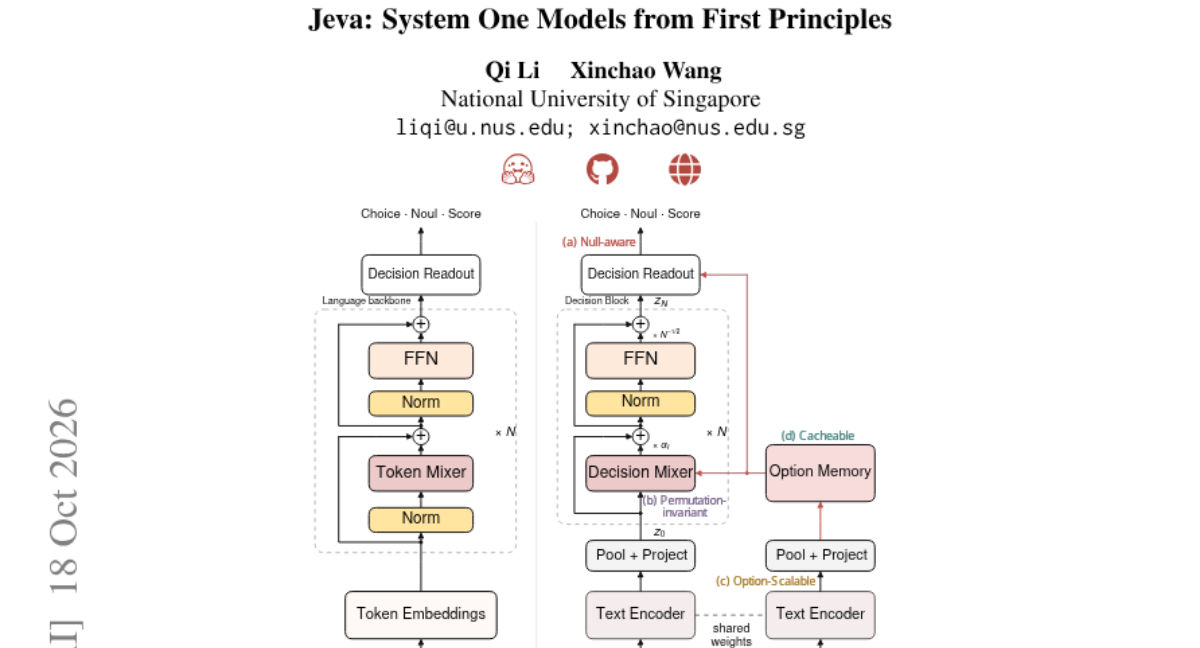
Jeva is a 4B “System One” decision model that makes choices directly (not via text), with built‑in support for multiple choice, “none of the above,” scoring, and robust behavior under option reordering.
The Details:
- Guarantees: null-aware, permutation-invariant, scalable to 2,048 options, and cacheable.
- Architecture: shared encoder for request + options, plus a small decision stack and symmetric aggregation.
- Tasks: unified Choice, Noul (null), and Score with near-perfect null detection and no observed permutation flips.
- Efficiency: >20× median latency speedups by reusing cached option representations.
Why It Matters:
Fixes core LLM decision issues (order sensitivity, weak “none of the above,” poor scaling) and makes large-scale ranking, routing, and retrieval both more reliable and much cheaper to run.
💡 Worth a Closer Look
Source: huggingface.co
Quick Brief:
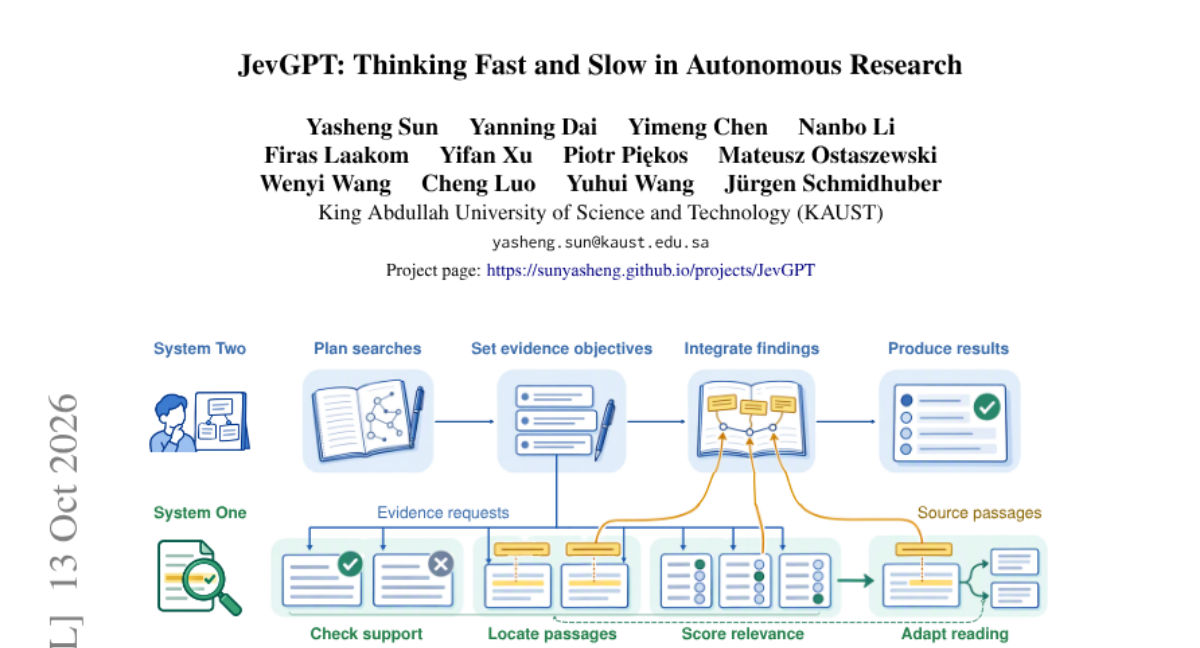
JevGPT is an autonomous research agent with a fast evidence finder and a slow planner, iteratively using evidence under tight token and cost budgets to outperform similar agents on QA and document ranking.
The Details:
- Dual-system: fast System One for search and ranking; slow System Two for planning and synthesis.
- Iterative loop: refines queries and passages instead of one-shot retrieval.
- Budget-aware: focuses on high-value documents to cut tokens, latency, and cost.
Why It Matters:
Enables human-like, multi-step, evidence-driven research that is more accurate and efficient on large corpora, and provides a fast/slow design pattern for future AI search agents.
📝 Also Noteworthy

Source: huggingface.co
Quick Brief:
VideoJev is a “System One” video model family (4B, 35B-A3B) that skips text generation and directly scores time segments and answer options, unifying temporal grounding and multiple-choice video QA at much higher speed.
The Details:
- Shared head outputs temporal intervals and answer scores (no autoregressive decoding).
- Cached/joint inference: encode video once, answer many or batched questions.
- Grounding: +6.7 / +10.8 mIoU over Qwen with 2.8–3.1× faster passes.
- QA: Qwen “Thinking”-level accuracy with >100× faster inference; code and checkpoints released.
Why It Matters:
Enables practical real-time, multi-query video agents and shows structured System One heads can replace slow token-by-token reasoning for many video tasks.
👀 One More to Watch
Source: huggingface.co
Quick Brief:
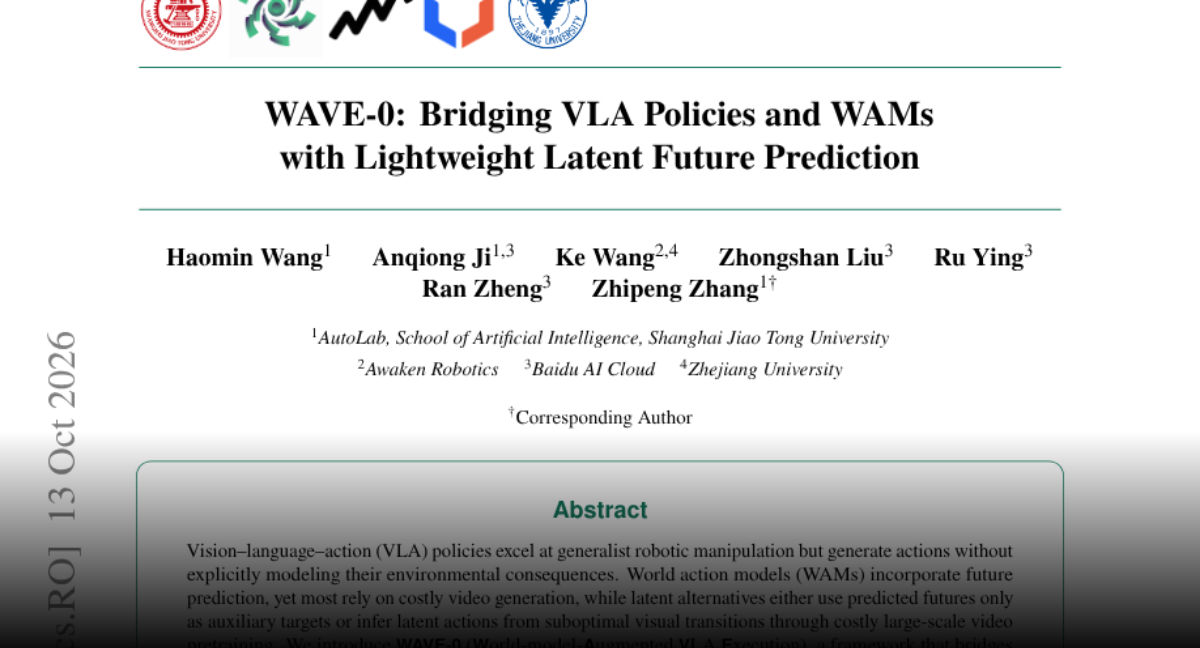
WAVE-0 is a 257M add-on to VLA (vision-language-action) policies that predicts future outcomes in latent space to choose better robot actions, trained only on robot data.
The Details:
- Predicts future latent states for candidate plans.
- Uses a counterfactual ranking loss; no video or pixel prediction.
- Gets 98.7% success in simulation; real robots: 38.3% → 73.3%.
Why It Matters:
Adds efficient “look-ahead” to VLAs, boosting robustness and real-world performance.
📚 More Worth Reading
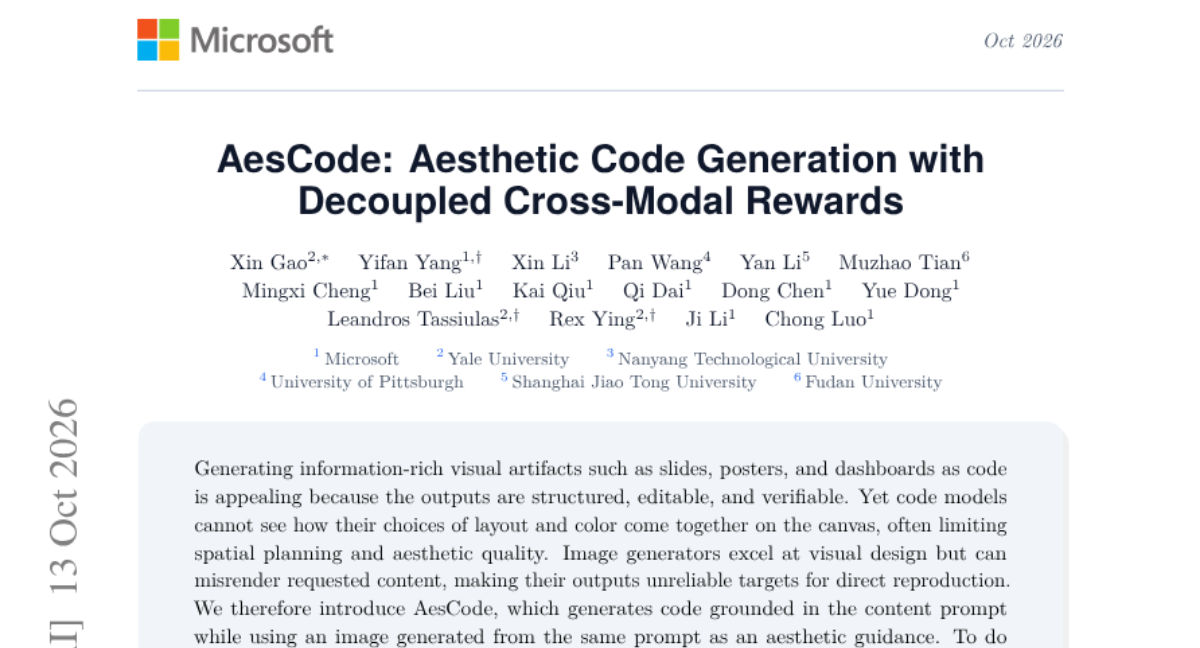 Decouples verifiable and aesthetic rewards for code-based visual design via a design-graph representation, cross-modal RL, and a VLM-based Visual Graph Rubric, substantially boosting layout quality and correctness over Qwen3-VL baselines on a new human-aligned benchmark.
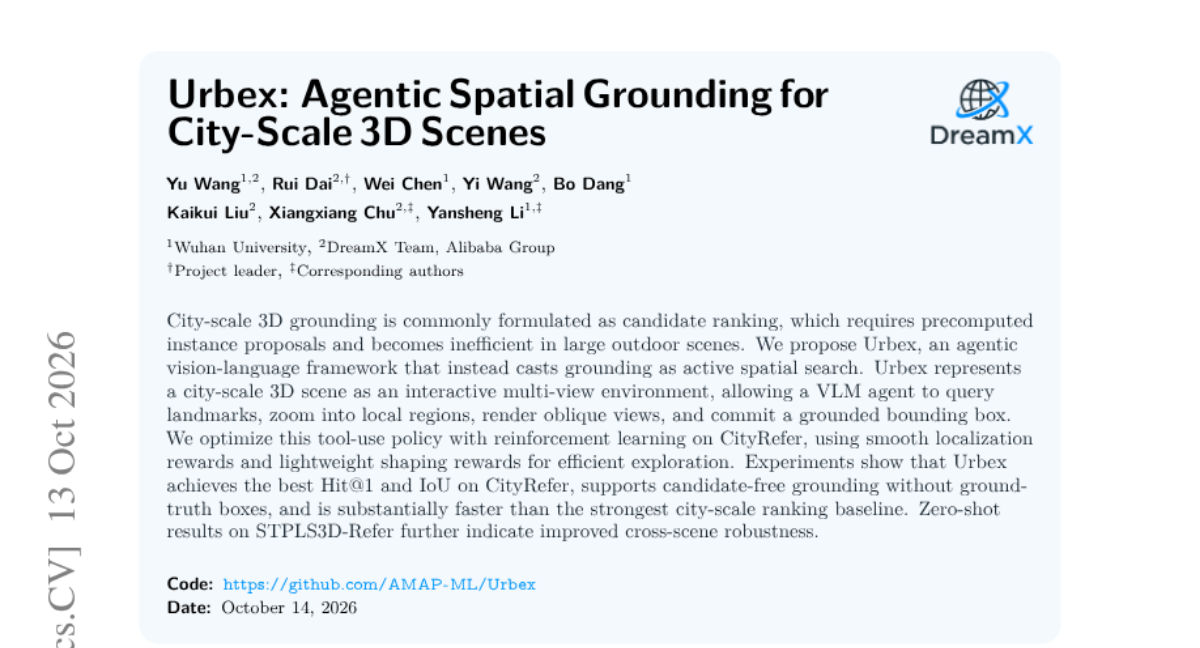 Agentic vision-language framework that treats city-scale 3D grounding as active spatial search, using RL-optimized tool use to navigate multi-view environments and commit bounding boxes, achieving state-of-the-art Hit@1/IoU with faster, candidate-free grounding and better cross-scene robustness.
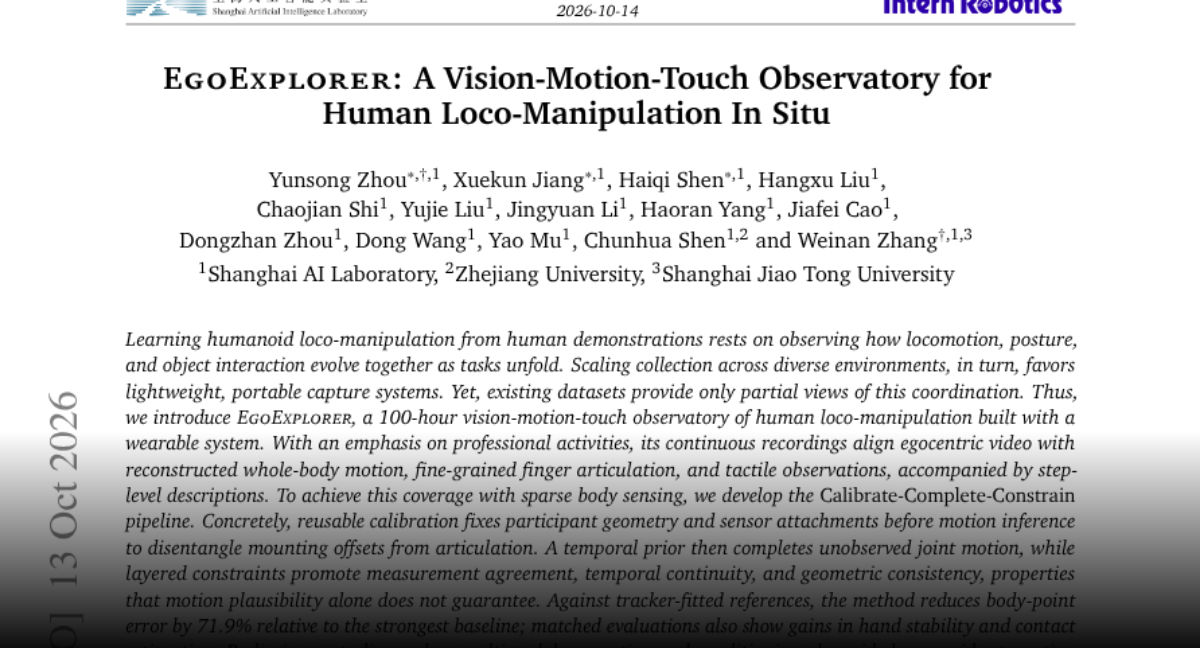 EgoExplorer: A Vision-Motion-Touch Observatory for Human Loco-Manipulation In Situ2026-10-14· huggingface.coPresents a 100-hour egocentric vision–motion–touch dataset of in-situ human loco-manipulation plus a Calibrate–Complete–Constrain pipeline that fuses sparse wearable sensing into accurate whole-body, hand, and tactile reconstructions, cutting body-point error by 71.9% over prior methods.
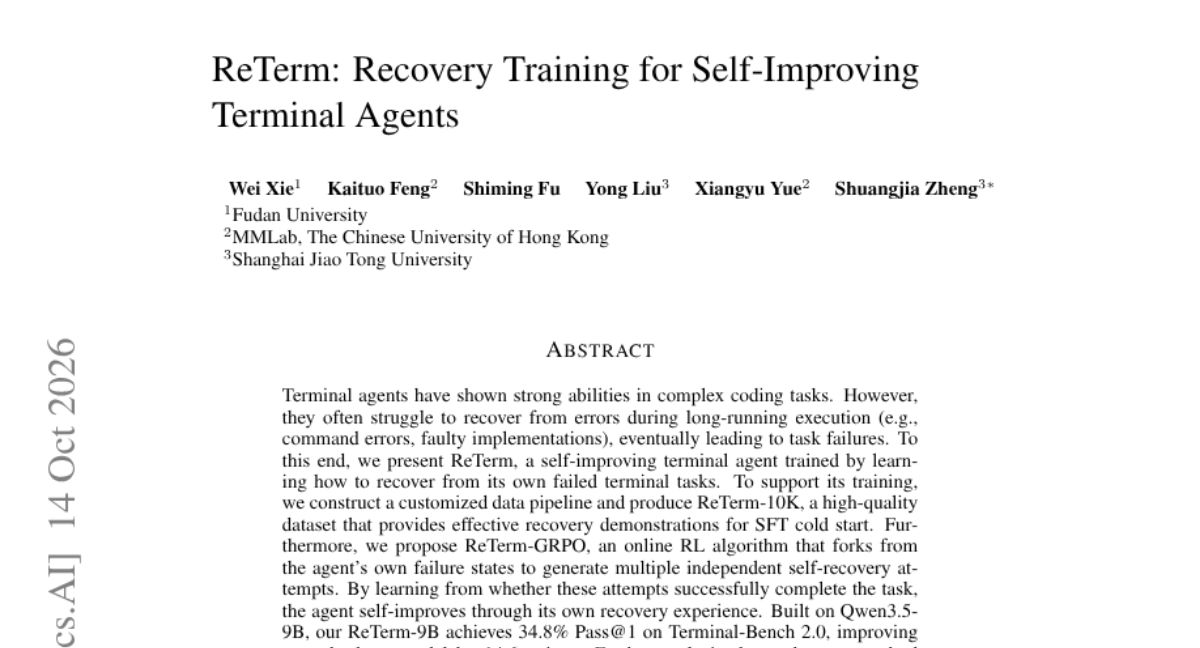 Introduces a self-improving terminal coding agent that learns to recover from its own failed runs via a curated ReTerm-10K recovery dataset and an online RL algorithm (ReTerm-GRPO), boosting Pass@1 on Terminal-Bench 2.0 by 14.6 points over the base model.
 Dyna-2: General Purpose Physical Agents with Hour-Long Autonomy — Jason Ma, Dyna Robotics2026-10-13· latent.spaceWorld-action model Dyna-2, trained on 1M+ hours of human video, enables Dyna-2.1 robots to execute reliable hour-long, long-horizon workflows and learn new tasks from ~45 minutes of demonstrations, showing scalable human-to-robot transfer for real-world physical autonomy.