October 1, 2026
🔬 Today in AI Research
From 41 articles considered today, here are the highlights — your daily brew.
📋 Today's Research
- Gemini 4 Argon launches as a frontier model aimed at real-world coding and enterprise knowledge work. (blog.google)
- SynthID Bio introduces watermarking methods built for synthetic biology to help label synthetic outputs. (deepmind.google)
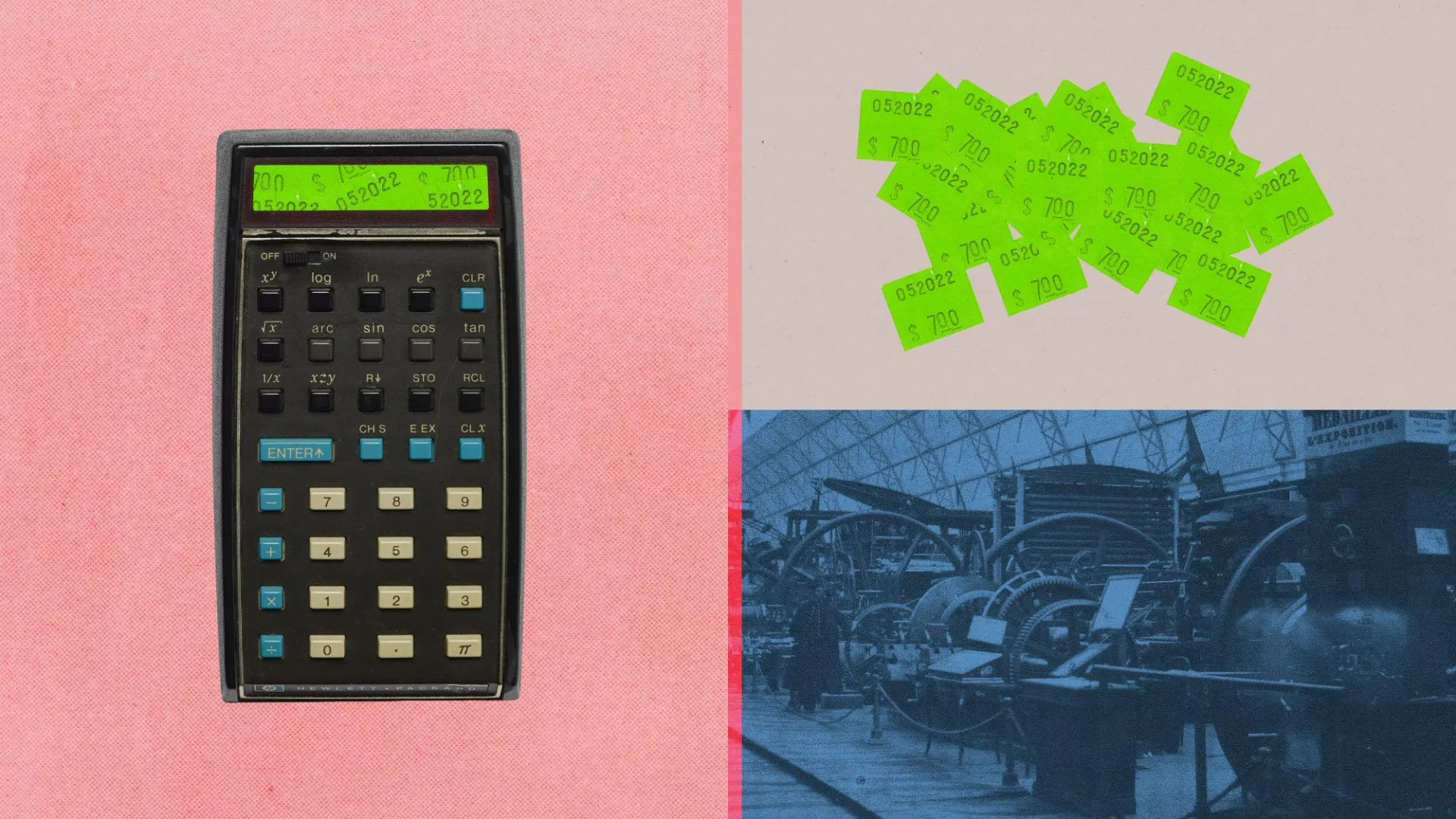
- Robot exposure estimates conclude robots can do 3/4 of US physical job work. (anthropic.com)
🔬 Research of the Day
Source: anthropic.com
Quick Brief:
Robots can already do about 75% of physical job tasks in the US (34% of work hours), but are rarely cheaper than humans. Adding LLMs, roughly 80% of work is technologically exposed, though real adoption will be gradual.
The Details:
- Robots handle most physical tasks in controlled settings; only a sliver of tasks are doable in fully unstructured environments.
- Most exposed jobs: drivers, warehouse and recycling workers, packers; care and repair work remain hard to automate.
- Exposed workers are disproportionately male, Hispanic, less educated, lower paid, and face higher unemployment.
- Robots are cost-competitive for only ~0.3% of tasks; at past price trends, just 10% of work becomes cheaper to automate in ~40 years.
Why It Matters:
Physical jobs—not just desk jobs—face rising automation risk. Impacts will fall hardest on already vulnerable, lower-wage workers. High costs make a rapid robot-driven employment shock unlikely in the near term.
💡 Worth a Closer Look

Source: deepmind.google
Quick Brief:
SynthID Bio watermarks AI-generated proteins and other biological designs with a hidden, verifiable signal in sequences and 3D structures, without changing function.
The Details:
- Uses tiny amino acid and coordinate tweaks to encode a detectable pattern.
- Lab tests show watermarked binders match originals.
- Built into AlphaFold 3 and used on an AI-designed bacteriophage genome.
Why It Matters:
Gives synthesis providers and databases a provenance signal to flag AI-designed biology, improving screening and biosecurity.
📝 Also Noteworthy
Source: huggingface.co
Quick Brief:
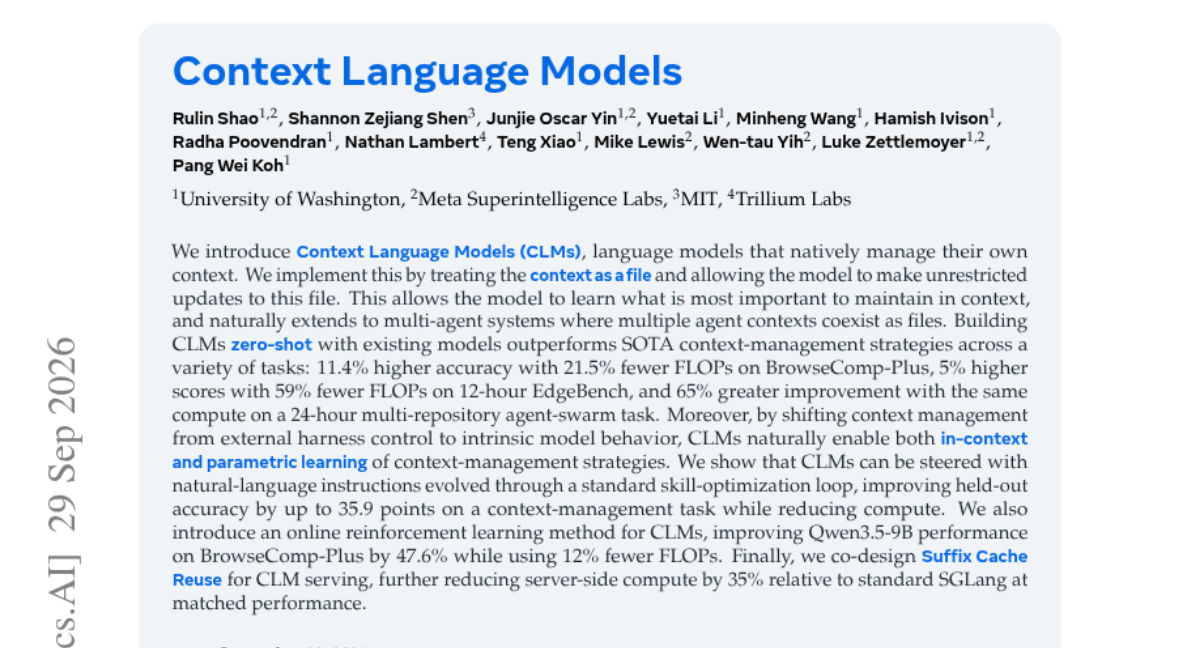
Context Language Models (CLMs) let models manage long-term context as a writable file, outperforming agent scaffolds with less compute.
The Details:
- Read/write a persistent “context file” instead of external heuristics
- Zero-shot CLMs beat SOTA on long-horizon benchmarks with 20–60% fewer FLOPs
- Support multi-agent setups and very long tasks
Why It Matters:
Puts context control in the model, making long-running agents cheaper, stronger, and systems simpler.
👀 One More to Watch
Source: huggingface.co
Quick Brief:
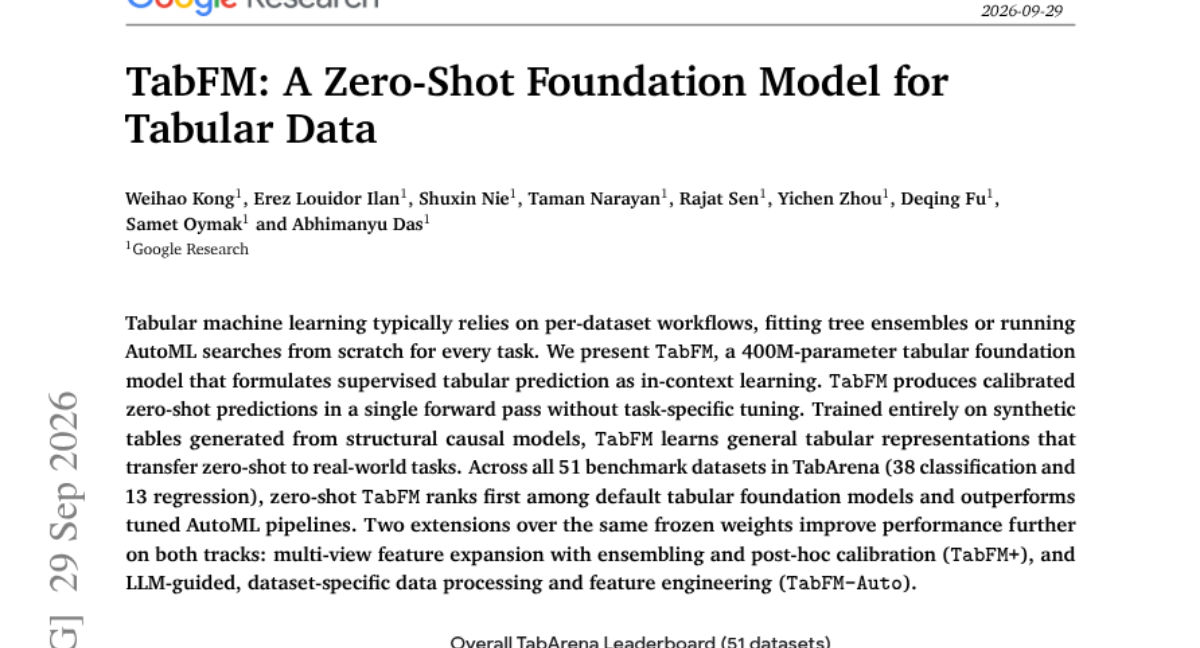
TabFM is a 400M‑parameter foundation model for tabular data that gives calibrated zero‑shot predictions from a single forward pass, trained only on synthetic causal tables.
The Details:
- In‑context learner over rows for classification and regression.
- Pretrained on synthetic tables from structural causal models, then used zero‑shot on real data.
- On 51 TabArena tasks, it beats default tabular FMs and untuned AutoML.
Why It Matters:
Makes tabular ML plug‑and‑play (no training/tuning) and cuts compute and engineering cost while keeping strong accuracy.
📚 More Worth Reading
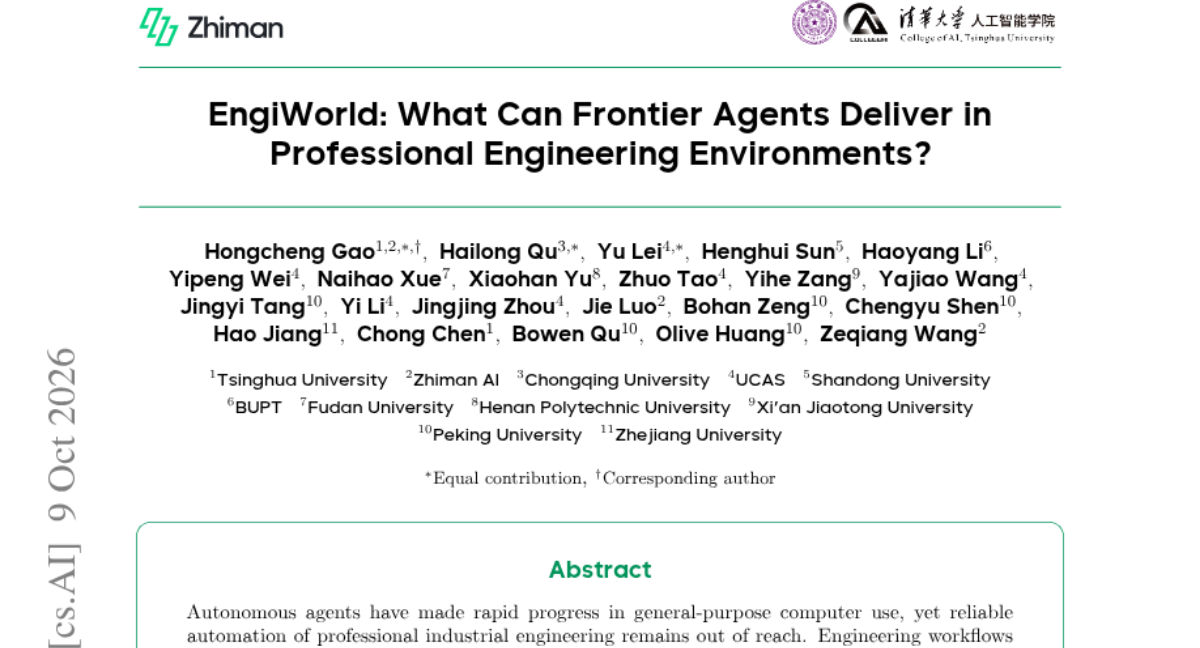 EngiWorld: What Can Frontier Agents Deliver in Professional Engineering Environments?2026-09-30· huggingface.coIntroduces EngiWorld, a 1,301-task, multi-domain benchmark and artifact-centric verifier for end-to-end engineering agents, showing current frontier models achieve only 44.3 EngiScore and 3.6% success on multi-software workflows, quantifying the gap to reliable industrial automation.
 Details a real-world “adversarial distillation” attack pattern, disruption timeline, and layered mitigations for protecting models’ hidden reasoning and cross-model security, including attribution to a Moonshot AI–linked cluster and shared defenses via the Frontier Model Forum.
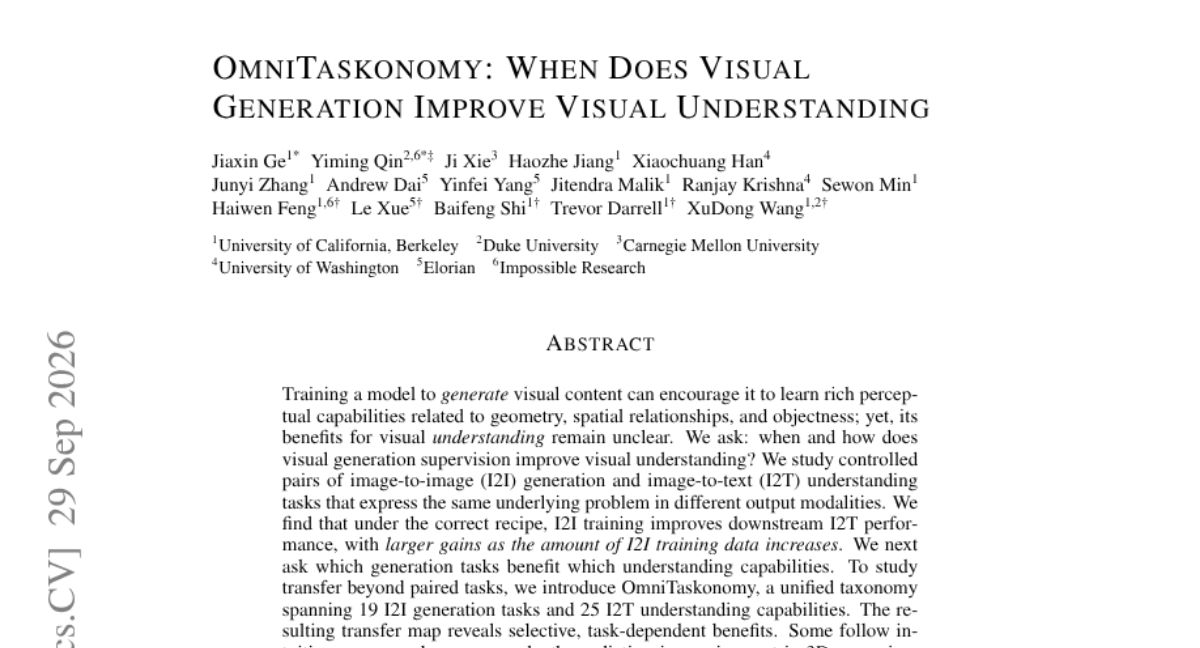 Shows that training on image-to-image generation can significantly boost image-to-text understanding, maps which of 19 generation tasks help 25 perception skills via the OmniTaskonomy transfer matrix, and links gains to gradient alignment to guide task and curriculum design.
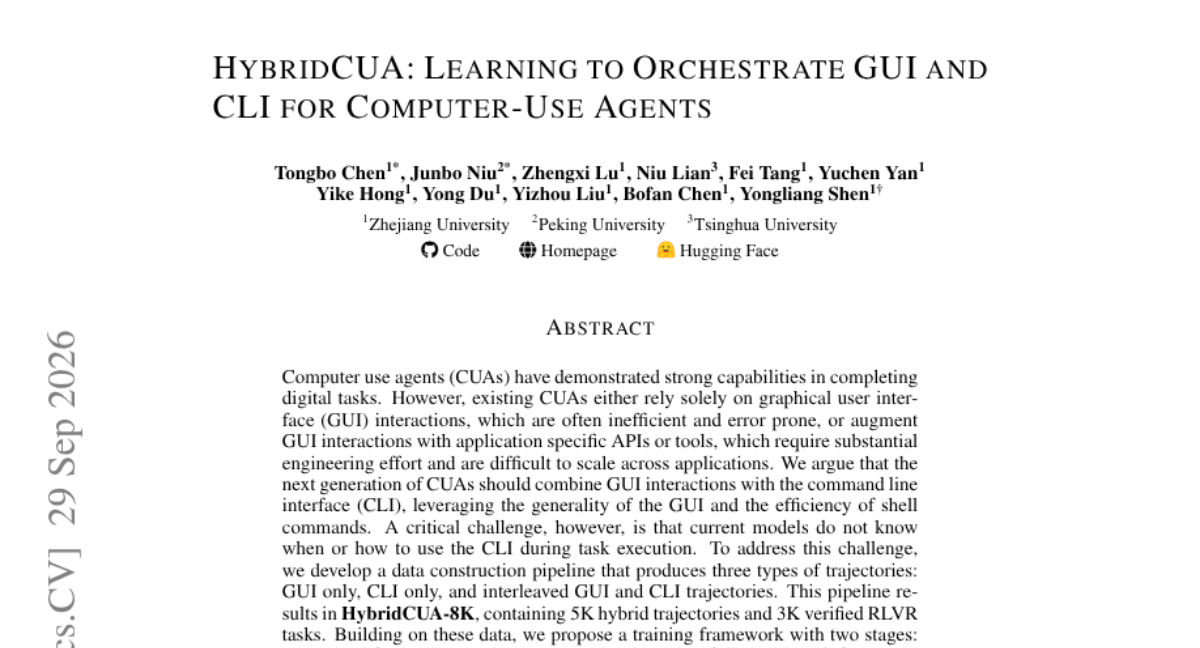 Data pipeline and two-stage SFT+RL framework that learn when to interleave GUI and CLI actions, yielding HybridCUA-9B with 53.6% OSWorld accuracy (+14.8 points) and +4.0 points on WindowsAgentArena, demonstrating efficient, cross-platform computer-use agents.
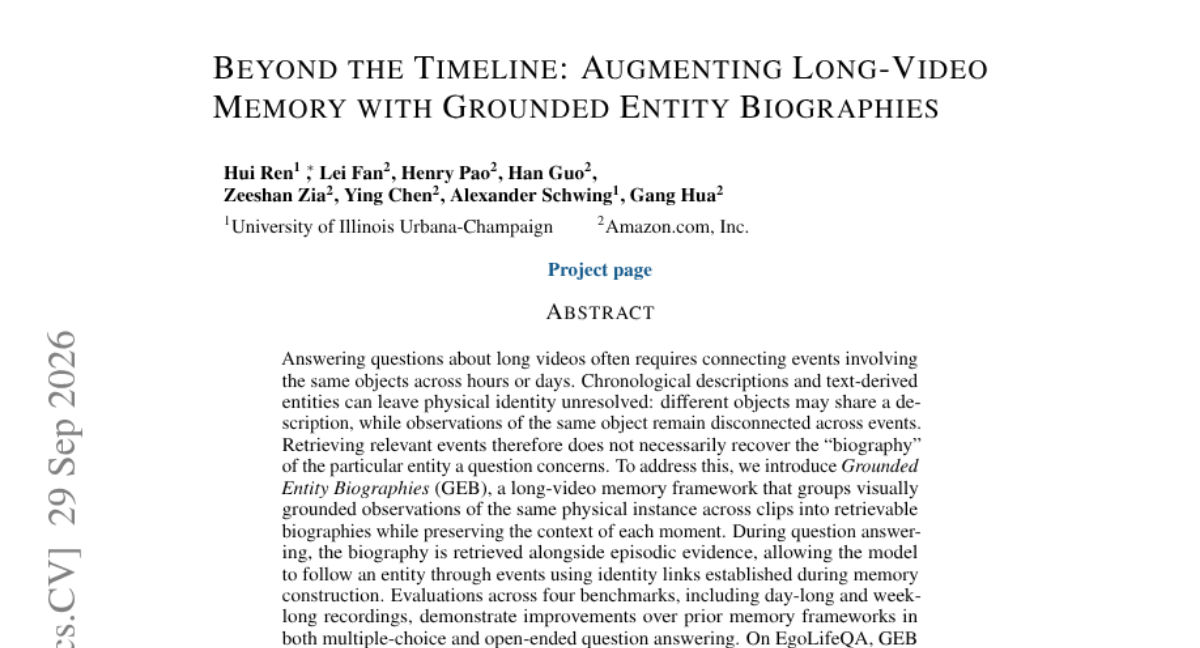 Beyond the Timeline: Augmenting Long-Video Memory with Grounded Entity Biographies2026-09-30· huggingface.coGrounded Entity Biographies (GEB) links visually grounded observations of the same physical entity across long videos into retrievable biographies, boosting long-horizon video QA accuracy (e.g., 72.0% on EgoLifeQA, +4.4 points over prior memory frameworks).
🏛️ Latest from Research Labs
- Announcing Gemini 4 Argon, our frontier model for real-world coding, enterprise knowledge work, and cyber defense, rolling out soon.
