August 28, 2026
🔬 Today in AI Research
From 42 articles considered today, here are the highlights — your daily brew.
📋 Today's Research
- Internal cybersecurity testing in July 2026 exposed an internal-only research model, prompting a review of how such evaluations are run and what changes come next. (openai.com)
- DeepMind pilots double-blind AI evaluations using cryptographically secure environments to keep proprietary benchmark details out of model access. (deepmind.google)
- Gemini Omni 1.1 Flash adds new developer controls plus generative video capabilities. (blog.google)
🔬 Research of the Day
Source: huggingface.co
Quick Brief:
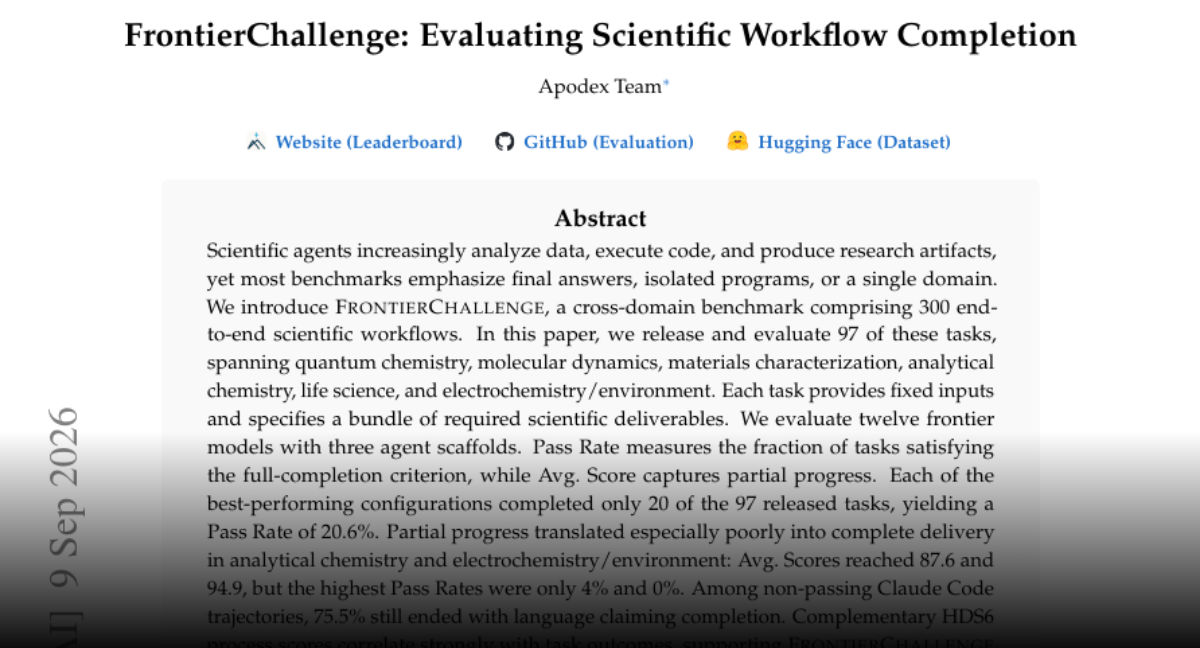
FrontierChallenge is a benchmark that tests whether AI agents can actually finish real scientific workflows end-to-end across multiple domains. Even top models fully complete only ~20% of tasks, while often (incorrectly) claiming they’re done.
The Details:
- 97 released tasks from 300 total workflows across quantum chemistry, MD, materials, analytical chemistry, life science, and electrochemistry/environment.
- Each task has fixed inputs and a checklist of required deliverables (code, figures, tables, written analysis).
- 12 frontier models × 3 agent scaffolds, evaluated by Pass Rate (all deliverables correct) and Avg. Score (partial progress).
- Best setups reach only 20.6% Pass Rate (20/97 tasks); some domains show high partial scores (up to 94.9) but near-zero full completion, and 75.5% of failed Claude Code runs still claimed success.
Why It Matters:
Shows that strong models and agents still struggle with complete scientific workflows, reveals dangerous overconfidence where “done” often ≠ actually done, and provides a more realistic bar for deploying AI agents in real scientific work.
💡 Worth a Closer Look
Source: huggingface.co
Quick Brief:
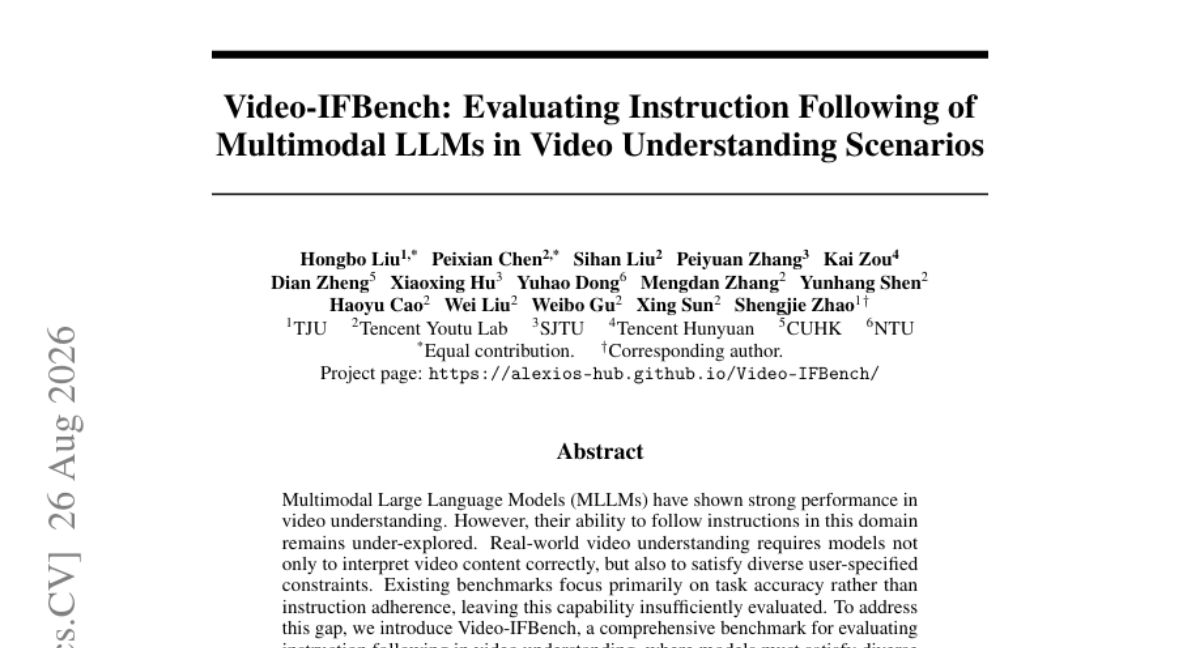
Video-IFBench tests if video MLLMs follow complex, constraint-heavy instructions, not just understand videos.
The Details:
- 4 instruction types, 32 tasks, 39 constraint categories.
- ~1.5K samples from a semi-automatic pipeline.
- 20+ models; strong drops on multi-constraint and conditional cases.
Why It Matters:
Real video assistants must follow nuanced constraints. Video-IFBench exposes current gaps and gives a clear target for improving instruction following.
📝 Also Noteworthy

Source: huggingface.co
Quick Brief:
Code World Model uses a coding LLM as a “world brain” to keep world state and rules in code, while a video model renders the visuals.
The Details:
- Dynamics from executable code, not pixels.
- State → compact proxy → proxy video for MiniMax‑H3.
- Trained on paired proxy–video data from games and real videos.
Why It Matters:
Enables persistent, rule‑consistent, long‑horizon worlds and separates logic from rendering for scalable, open‑ended environments.
👀 One More to Watch

Source: huggingface.co
Quick Brief:
VBVR-Pro is a 300-task benchmark for native visual reasoning, where models reason by generating images or videos.
The Details:
- Procedural tasks with strong transfer to 7 external visual reasoning benchmarks.
- Deterministic, rule-based scorers replace VLM-as-a-judge as RL rewards.
- Benchmarks 30+ image, video, and interleaved generators; video excels at long-term tracking.
Why It Matters:
Provides a scalable, RL-ready setup to train and compare visual reasoning models with reliable, verifiable feedback.
📚 More Worth Reading
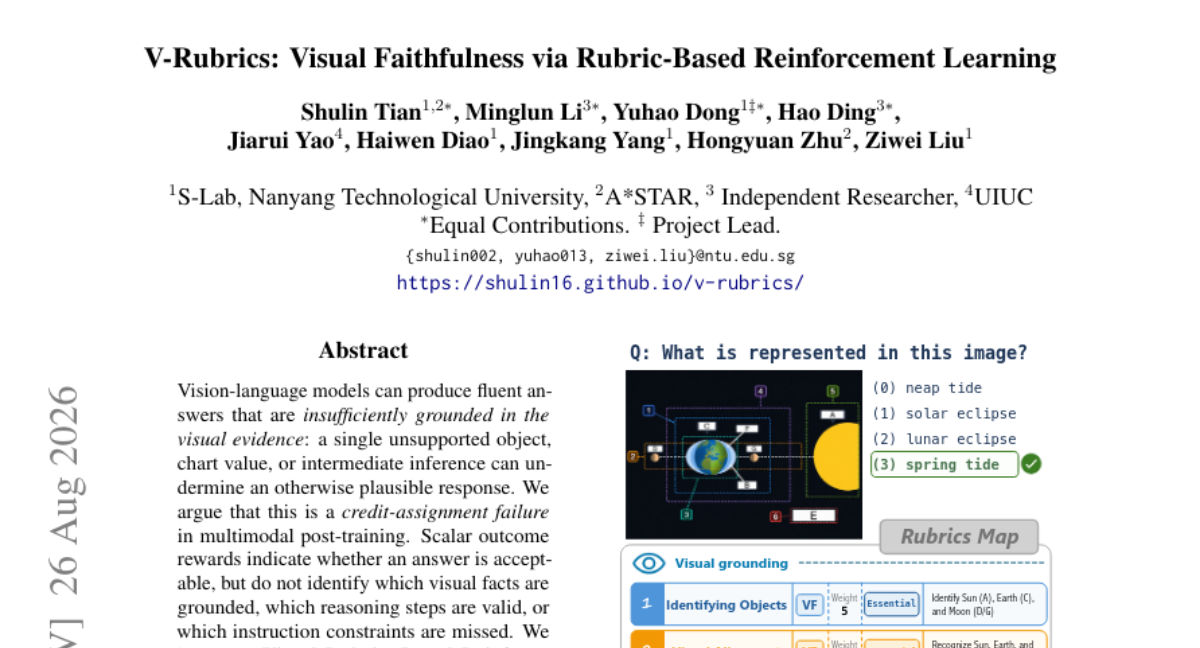 Visual Rubrics-Based Reinforcement Learning decomposes reference answers into atomic propositions and uses rubric-based rewards over visual faithfulness, reasoning consistency, and instruction following to improve multimodal post-training on visually grounded reasoning benchmarks.
 Dual-brain streaming memory architecture for speech language models that boosts top-5 retrieval vs. Mem0, achieves state-of-the-art persona and affect modeling, and delivers 134 ms real-time, low-cost memory I/O for personalized, emotionally aware voice interaction.
 MA-VLA: Multi-Arm Vision-Language-Action Model for Collaboration and Compositional Generalization2026-08-27· huggingface.coDecomposes multi-arm manipulation into per-arm atomic prompts plus an Arm Shuffle permutation scheme, enabling role-agnostic instruction following and strong compositional generalization to unseen multi-arm collaboration patterns in both simulation and real-world benchmarks.
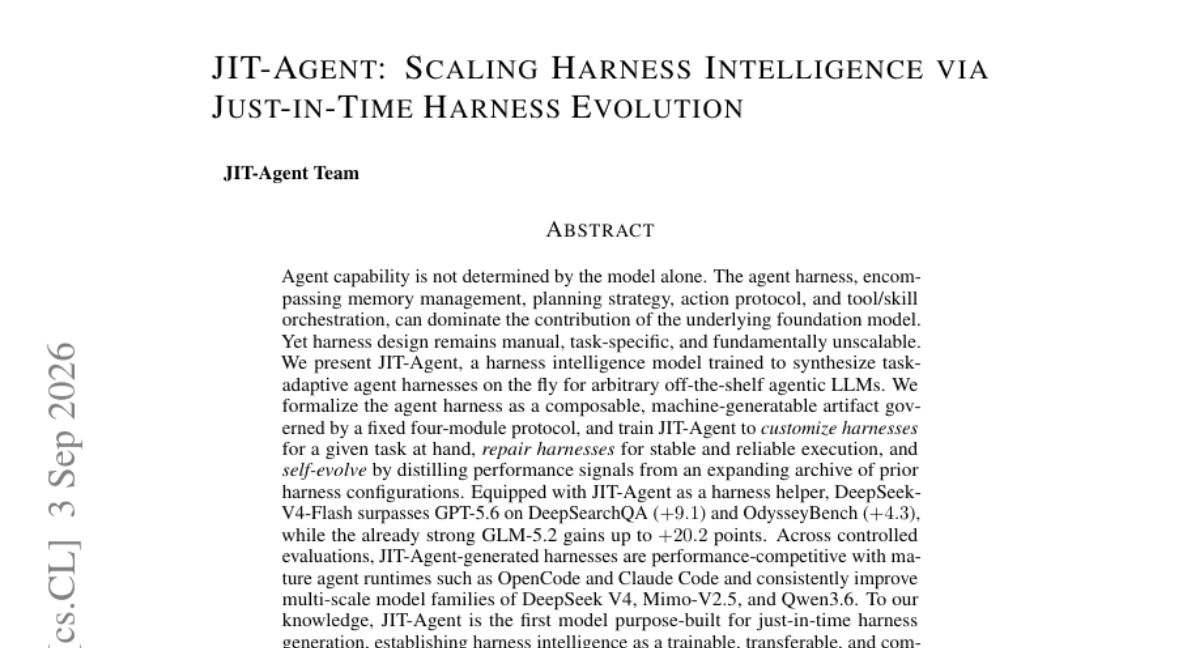 JIT-Agent: Scaling Harness Intelligence via Just-in-Time Harness Evolution2026-08-27· huggingface.coTrainable model that generates, repairs, and self-evolves task-specific agent harnesses for arbitrary LLMs, boosting tools like DeepSeek-V4-Flash and GLM-5.2 to outperform stronger baselines and showing harness intelligence as a scalable, model-agnostic capability.
 StreamPI: Streaming Multimodal Temporal Modeling for Vision-Language-Action Models2026-08-27· huggingface.coInstruction-anchored temporal attention and randomized-interval streaming training add parameter-free temporal reasoning to single-frame VLA models, improving real-robot manipulation and LIBERO benchmark performance while remaining compatible with pretrained single-frame weights.
🏛️ Latest from Research Labs
 Ai2 and Providence Swedish Cancer Institute partner to advance AI-assisted scientific discovery2026-08-01· allenai.orgAi2 and Providence Swedish Cancer Institute are expanding their collaboration after AutoDiscovery helped…
- Building trust in proprietary model benchmarks using cryptographically secure environments
 Gemini Omni 1.1 Flash brings a new suite of creative controls and generative video capabilities to developers.
 Now you can get more intelligent speech-to-text transcription with Gemini 3.5 Transcribe.
